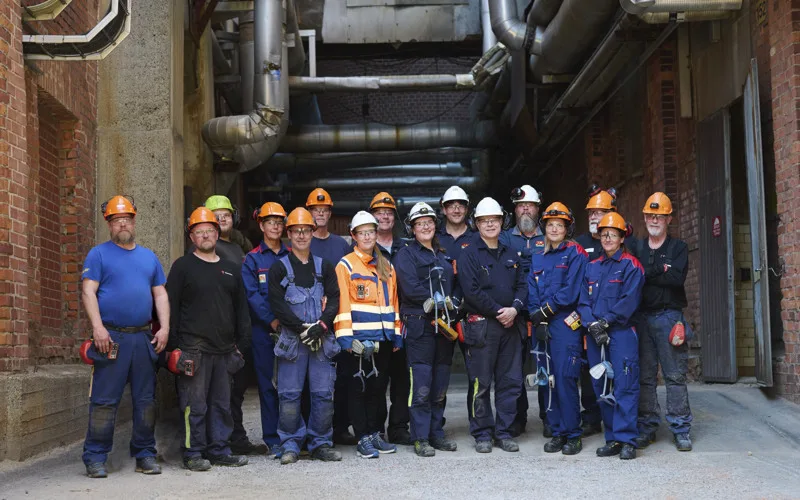
Many people know about Domsjö Fabriker, but few know
what we actually do.

Now we want to tell it, we call our story Domsjö Was Here!

Welcome to our world – from trees to sustainable sausage skins, clothing, high-speed tires and much more.

We are where you least expect it.

"We do not make paper"

Camilla Nyberg and Fredrik Östlund both work as marketing managers at Domsjö Fabriker but are responsible for different types of products.

While Camilla is responsible for lignin and ethanol sales, Fredrik focuses on cellulose. Sales take place all over the world.

To find out more about Domsjö’s raw materials and the various end products they end up in, we meet up with Camilla and Fredrik at the office.

What do you produce most of at Domsjö Fabriker?

“Cellulose is our biggest business area, our main product and the basis of our production”, Camilla explains and continues: “We also deal with the by-products of cellulose production, which are further processed into sustainable products.

Fredrik adds: “Our process is based on making more of the tree, where all process flows are connected”, and continues:

“Cellulosic sheets are also produced in a wide range of variants. We have the ability and knowledge to produce with the properties that customers want.”

How many variants are there?

About fifteen of them. By refining several different properties of cellulose, right down to the molecular level, we can customize each production,” says Fredrik Östlund.

"Our process is based on making more of the tree"

Fredrik Östlund

So different types of cellulose end up in different end products?

“Exactly. We have different recipes depending on which customer’s specification we produce for. For example, one type of our cellulose is used for making sausage skins, another for making thread (cord) in high-speed tires. The cellulose is also used in a variety of other applications.”

And so you make lignin in the factory?

“Yes, we make lignin from the cooking liquid from the cellulose process,” Camilla explains, and continues: “Lignin is largely used as a dispersant in concrete. The lignin improves the properties and makes the concrete more flowable.”

What else can lignin be used for?

“It can also be used in animal feed pellets, for example for reindeer, cattle and chicken feed. There it acts as a binding agent. So in this case, the lignin has the opposite properties, i.e. it helps to bind the feed to the pellets.”

"Lignin can be used in a wide range of applications - from concrete to animal feed"

Camilla Nyberg

And so you make bioethanol?

“Yes, it is also a by-product of pulp production, and most of the bioethanol we produce is sold as a fuel blend on the European market.”

Are your customers developing the final products?

“Yes, that’s our business model,” says Fredrik. “We are experts in the raw material, but it is our customers who develop and produce the final product and are experts in that part.”

Do your raw materials make your partners’ products more sustainable?

Camilla: “Yes, I think so. We make renewable products from renewable raw material, using the whole tree, which gives us a strong sustainability profile and a positive impact on the final CO2 footprint.

Fredrik adds: “Parts of our process are completely unique, for example we have completely chlorine-free bleaching combined with a closed bleach plant.”

Does everyone know what you at Domsjö Fabriker actually produce?

“A common misconception is that we produce paper at Domsjö Fabriker. As I said, what we mainly produce is something completely different, namely cellulose, which is used for completely different applications,” Fredrik replies. “

"Lignin is a green chemical, originating from the forest."

Camilla Nyberg

Domsjö is one of the leading producers of lignin in the world. Our lignin is delivered to some 60 destinations worldwide.

Domsjö is one of the leading producers of lignin in the world. Our lignin is delivered to some 60 destinations worldwide.

Domsjö is one of the leading producers of lignin in the world. Our lignin is delivered to some 60 destinations worldwide.

Meny

Menu